How Can I Optimize My Content for AI Search?
Dear Will & AiME,
We’ve been investing heavily in Search Engine Optimization (SEO) for years, optimizing keywords, links, load times and meta descriptions. But now that more users are asking AI systems like ChatGPT, Google Gemini, and Claude for direct answers, I’m wondering: Does our content show up in those systems? How do we optimize for new ways of searching?
— Digital Marketing Director in Chicago
Short answer 💡
To optimize for AI search, businesses should structure content clearly, build external credibility, and focus on being cited in AI-generated answers—not just ranking in search results. A strong GEO strategy complements SEO by improving visibility in generative AI systems.
Dear Digital Marketing Director in Chicago,
You’re not imagining it—how people search is changing. As users increasingly turn to generative AI tools instead of traditional search engines, the rules of visibility are shifting.
The good news? There’s a name for what you’re describing: Generative Engine Optimization, or GEO. While it’s still early days, there are already clear steps you can take to adapt.
Let’s walk through what GEO is, how it differs from traditional SEO, and how your team can take action.
What Is Generative Engine Optimization (GEO)?
Traditional SEO helps you rank in traditional search results. GEO helps you show up in AI-generated answers—those single, summarized responses AI tools give when users ask a question.
If someone asks, “What’s the best brand for noise-canceling headphones?” an AI system might scan hundreds of sources to generate one answer. GEO is about making sure your brand, content, or language is part of that answer.
As generative tools become more widely adopted, GEO is quickly becoming a critical part of content strategy. It is not a replacement for SEO, but a necessary complement to it.
How GEO Differs from Traditional SEO
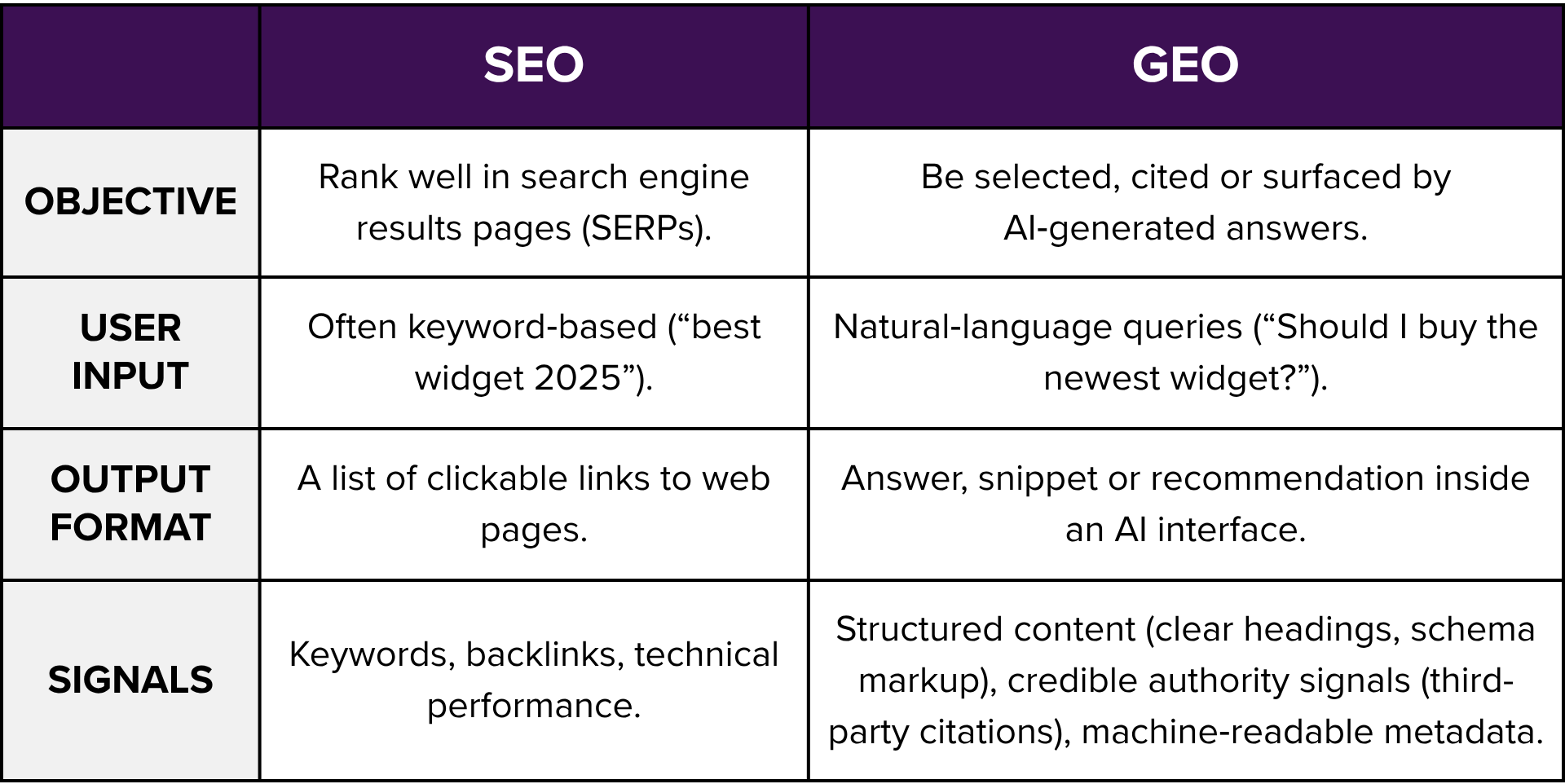
What GEO Means for Your Content Strategy
Structure Matters:
AI systems favor clearly organized content. Use consistent headings, supporting data, explicit statements of expertise, and include sources. The goal is to make your content easy to parse, not just for humans, but for machines.Prioritize PR:
Traditional SEO emphasized backlinks. These still matter, but GEO also looks for third-party credibility—mentions on industry blogs, citations in white papers, interviews, news articles, and other signals of expertise that AI models can use as evidence of authority.Your IP May Be in the Mix:
If your content is being consumed by AI engines, either for training or inference, consider how you assign rights, track usage, and protect your IP. You may not only want traffic, you may want citation or reuse.Traditional Metrics May Fall Short:
GEO success isn’t necessarily reflected in page visits. Instead, look at citations in AI answers, inclusion in AI‑generated “overviews”, or references in discourse. Traditional analytics tools may not capture this fully yet.Early‑Adopter Advantage:
GEO is still evolving, which means early adopters have an advantage. The earlier you refine your structure, authority signals, and metadata, the more likely AI systems are to treat your content as credible and relevant.
A Practical GEO Roadmap for Businesses
Audit your core content: Identify high-value pieces you want surfaced in AI responses, such as thought leadership, FAQs, and case studies.
Re‑structure for clarity: Use defined headings, present facts succinctly (avoid fluff), remove ambiguity, and cite sources where appropriate.
Extend visibility off‑site: Secure mentions, guest contributions, and third‑party references to your brand or content topics.
Use metadata & machine‑readable formats: Consider schema.org markup, structured FAQs, and clear author credentials.
Monitor changes in AI interfaces: Test queries in popular generative engines like ChatGPT, Gemini, and Perplexity to see if your brand or content appears, and how.
Adapt IP & rights frameworks: If your content may be mined by AI, adjust your licensing, terms of use and tracking accordingly.
GEO doesn’t replace SEO, it complements it. This represents a fundamental shift from competing for clicks to vying for citation, visibility, and reuse within AI‑generated responses. Ignoring this trend could mean your brand, despite strong traditional SEO, may be absent from the next wave of digital discovery. Presence in AI answers is not guaranteed, but preparation increases the probability.
— Will & AiME
Three Takeaways
Generative Engine Optimization (GEO) is emerging as a complement to SEO, helping brands appear in AI-generated answers—not just search results.
AI visibility depends on clear organization and external credibility. Well-structured, sourced, and widely referenced content is more likely to be surfaced or cited by generative systems.
Early adopters have an advantage. Taking steps now to audit, refine, and structure your content increases the likelihood your brand will appear in the next generation of search.